Waitangi week has brought Minister for Māori Development Tama Potaka to Te Tai Tokerau and one of his first stops was a powerful example of Māori land development done right.
Published: Rāpare, 05 Huitanguru, 2026 | Thursday, 5 February 2026
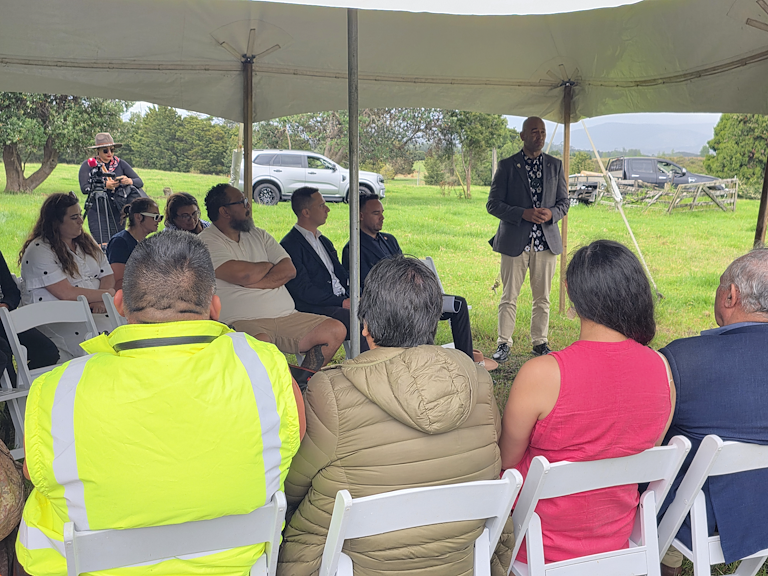
The Minister joined Māori Trustee Dr Charlotte Severne and representatives of the Ōmāpere Rangihāmama Trust and kaimahi from Te Puni Kokiri on their whenua near Kaikohe, where a once-fragmented block of Māori land has been transformed into a thriving and diversified operation supporting more than 4,000 shareholders.
The Trust administers around 1,991 hectares of Māori land, much of which had historically been taken under the Māori Affairs Act 1953. Since 2007, the whenua has been progressively bought back — with full Māori ownership finally achieved in October 2025.
Standing overlooking the farm, Minister Potaka acknowledged the significance of both the whenua and the journey the Trust has taken.
“This is a powerful story of determination, partnership and vision,” said Minister Potaka.
“What we’re seeing here is Māori taking back control of their whenua and building long-term prosperity for whānau, while protecting what is sacred and unique about this place.”
A key part of the Trust’s success has been its partnership with Te Tumu Paeroa – Office of the Māori Trustee. Through a Limited Partnership model, the Māori Trustee provided capital to purchase the cows and Fonterra shares needed to establish the dairy operation, while the Trust funded the milking shed and dairy platform.
Like many Māori land developments, the journey wasn’t without its challenges. Early years were tough, with low milk payouts and operational hurdles slowing progress. But after shifting to a contract milker model — with strong whakapapa connections to the whenua — the farm turned a corner and became profitable.
The success of the venture allowed the Trust to repay the Māori Trustee’s investment and successfully exit the partnership, leaving the Trust in full control of its dairy operations.
Dr Charlotte Severne said the kaupapa reflected exactly what Te Tumu Paeroa aims to achieve “This partnership was about empowering the Trust to unlock the potential of their whenua — without ever putting ownership at risk.”
“Access to capital is one of the biggest barriers for Māori land development. By working together, we were able to fast-track a successful business that now delivers real benefits back to its people.”
Today, the Ōmāpere Rangihāmama Trust operates a diversified portfolio including dairy, beef, forestry, housing and horticulture — all guided by principles of kaitiakitanga, whānau wellbeing and long-term sustainability.
The whenua also holds deep cultural significance. The property includes Lake Ōmāpere, the only Māori-owned lake in Aotearoa and Maunga Pūtahi, a sacred Ngāpuhi site home to historic burial caves. All wāhi tapu across the whenua are carefully protected and fenced, with some areas vested in Ngā Whenua Rāhui.
For Minister Potaka, the visit set the tone for his time in the north, “This is what success looks like, strong governance, the right support, and a deep respect for whenua and whakapapa. It’s inspiring to see how Māori land can drive economic opportunity while protecting taonga for future generations.”